
Long Black Oceans
Michael S. Hart and the Lost Cyberspace of the Nineties

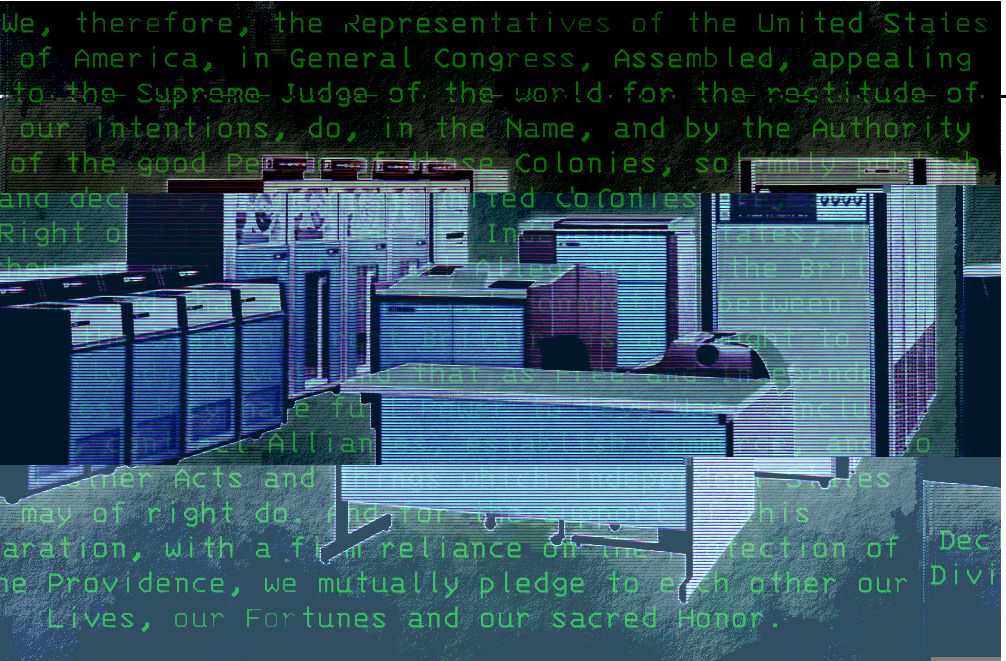
Every year when the Fourth of July passes by, a somber warning note always sings how the summer, too, is going to end. Make your beachy nostalgia moments now, because it’s going fast—these are the good old days of yore. Wistful, plaintive, strong—I love it and I hate it how it sings. But this year, with all the extra stuttered bangs and popping clangs of fireworks, I found myself thinking back to a much older, stranger Fourth of July. It was a revolution seen on a monochrome screen, on a day before I was born—I’m thinking of the events of July 4, 1971.
On that holiday afternoon, in a cold computer room at the University of Illinois Materials Research Lab, a student named Michael S. Hart sat down with what was basically a million-dollar gift. Back then, usage time on a massive mainframe computer cost a fortune—much like AI processing time does today—and Hart had been given pretty much carte blanche to do what he wanted.
What he wanted was to create a book on the computer.
As incredibly simple as that sounds, nobody had ever done it. Books were physical objects printed on paper; computers were for industrial calculations. They were entirely different worlds. At that exact moment, Carole King’s “It’s Too Late” was the number one song in the country. But for Hart, it wasn’t too late. He spent that Fourth of July afternoon in an act of rebellion, typing out the text of the Declaration of Independence into a terminal of a hulking Xerox Sigma V mainframe.
It was eBook number one of what he would come to call Project Gutenberg. His plan sounded like it came from a sci-fi paperback: he wanted to collect and give away billions of electronic books, building digital repositories that would dwarf all of history’s physical libraries and be accessible anywhere on Earth. Michael associated computers entirely with literature. That was why, a quarter-century later, I got along with him so well.
By the mid-1990s, the places I hung out online were the idiosyncratic nooks of cyberspace where people like Hart still lingered. Places like the Bookpeople mailing list, where bookish litheads would debate the inevitability of online text. Hart had a custom signature file taped to the end of his emails that proudly informed you he was “Internet User 100(tm).”
A quarter century after he’d typed that first document, I approached him about releasing mine. I’d just finished my first novel, Sunclipse—a first-person story about young love, and the ache of a narrator breaking away from childhood into the alternative underground of the ‘90s just as high school ends. It seemed obvious to me that all novels, and art generally, should live on the net, accessible to anyone, anywhere, forever.
Releasing a contemporary indie novel through Project Gutenberg had never been done. But Hart didn’t hesitate. He said yes.
By then he had a small team of volunteers running the project out of Illinois Benedictine College. It was growing, and using it as a launchpad for contemporary literature felt like the next great paradigm shift. He told me that non-fiction authors like Bruce Sterling and Steven Levy were already using the platform. So I FTP’ed the raw text file of Sunclipse using the kind of ASCII typographical conventions we developed back then—like surrounding a word with underscores to indicate italics. It was a secret handshake; doing so marked the exact difference between a true nethead and someone who hadn’t ever been in cyberspace before. Years later, those exact conventions we came up with were codified into Markdown and similar text schemes.
Soon, Sunclipse appeared on the Project Gutenberg servers, sitting directly alongside the public domain giants of world literature. I felt like a massive cultural shift was about to drop.
What really happened, though, was a vast, digital silence. I felt long black oceans, and their impenetrable depths, their wide and hidden vistas, all hanging there in a frightening vacuum of sound and motion before me. I could never plumb it all, but I could sense it—it was there. The waters were still, like a black, quiet static. Within hours, Sunclipse was indexed on AltaVista and the other search engines of the time. Google wasn’t there yet.
The book was downloaded; it was likely read. But the mainstream culture moved on as if the computer underground didn’t exist. Regis and Kathie Lee had traditional authors on their morning program, Publishers Weekly was printing its paper reports of book deals, but nobody was thinking about online lit. My book was technically accessible anywhere there was a dial-up connection, but publishing a digital novel was a paradigm no one could see. The infrastructure wasn’t there, and the cultural vocabulary didn’t yet exist to understand it.
Yet, I kept corresponding with Hart for years. I loved getting email from him because of a profoundly quirky habit: his text was always perfectly center-justified. He chose and ordered his words so that they would align precisely along both the left and right margins of an 80-column screen. He literally thought in block-justified ASCII.
During those years, books like Sunclipse and other net narratives like Summer Rain were part of a vitalic and parallel history of cyberspace. We had active mailing lists like Linart, dedicated to making open-source art of every kind with Linux and open-source tools. People were creating “net.art” on the Web, huge global discussions were unfolding on Usenet, and digital zines with original poetry and fiction came into your inbox. If you were there, you knew it.
And now, you don’t. All of that has been forgotten ten thousand times over. You can’t even search for the archives of those places; whole communities like Linart have been entirely wiped from the digital record. If you don’t already own a copy on a physical hard drive or printout, you’ll never know they existed.
Today, the milestone we set feels thoroughly obscured. If you look at the live Project Gutenberg index now, Sunclipse is gone. Like Summer Rain, and like a lot of underground books from that era, it was depublished.
In the early 2000s, as the net commercialized and copyright laws became aggressively litigious, Project Gutenberg had to strictly formalize its catalog to survive. They did it by quietly sweeping away the experimental, contemporary ASCII files of the ‘90s underground to focus exclusively on the deep past and verifiable public domain works. Michael Hart passed away in 2011, and the net we knew was replaced by a bland and boring corporate megamall, with no connection to the cyberspace that came before.
My relationship with the Internet today is entirely ambiguous. I am permanently plugged in, yet always trying to step away. It used to be that the net was happening, but now, today, everything great is going on offline. All my best adventures these days are off the net.
But the net eventually bent toward the exact kind of “open content” distribution we were prototyping back then. Project Gutenberg now holds over 78,000 books. Creative Commons has become an institution. There is a great joy to holding hardcopy, but everybody understands that books are also digital. Hart’s galactic vision has pretty much come to pass.
In the music world, a whole major genre—vaporwave and its hundred variants—was born of that exact attitude, trying to recapture the feel and atmosphere of early cyberspace and the ephemeral world we knew firsthand, but that no longer exists. It even used the same distribution model; for the nearly twenty years of its existence, vaporwave was freely copiable, downloadable music you found in esoteric pockets of the Web.
It succeeded, of course, and came out victorious. Recently, a comprehensive documentary on the story of vaporwave, Nobody Here, was released after a half-decade in the making. It feels like the genre is only moments away from its first massive, mainstream crossover hit. I love it with all my heart but am already cringing and ducking in preparation for the inevitable satires, parodies, and counter-movements. It has become a generational vocabulary, and it’s only natural that my record store, The Current Year, has so much of it. I have to. Whether the memory was made somewhere on a screen or in some nostalgic, fading summer, it was literally the music of my life.
While I enjoy all your articles, Michael, I especially liked this one. You are quite the internet pioneer! (I am reminded of the difference between the internet of that era, and the later web). I am sorry your work was since wiped from the site, but I am glad you had a great collaboration with the founder.